One producer chose to preserve a successful dense brownie recipe. The cutting process changed instead.
Product family
Brownie Is a Family, Not a Single Product
Different recipes create different textures, structures and production challenges.
Before comparing cutting technologies, it is worth understanding which brownie the producer wants to keep making.
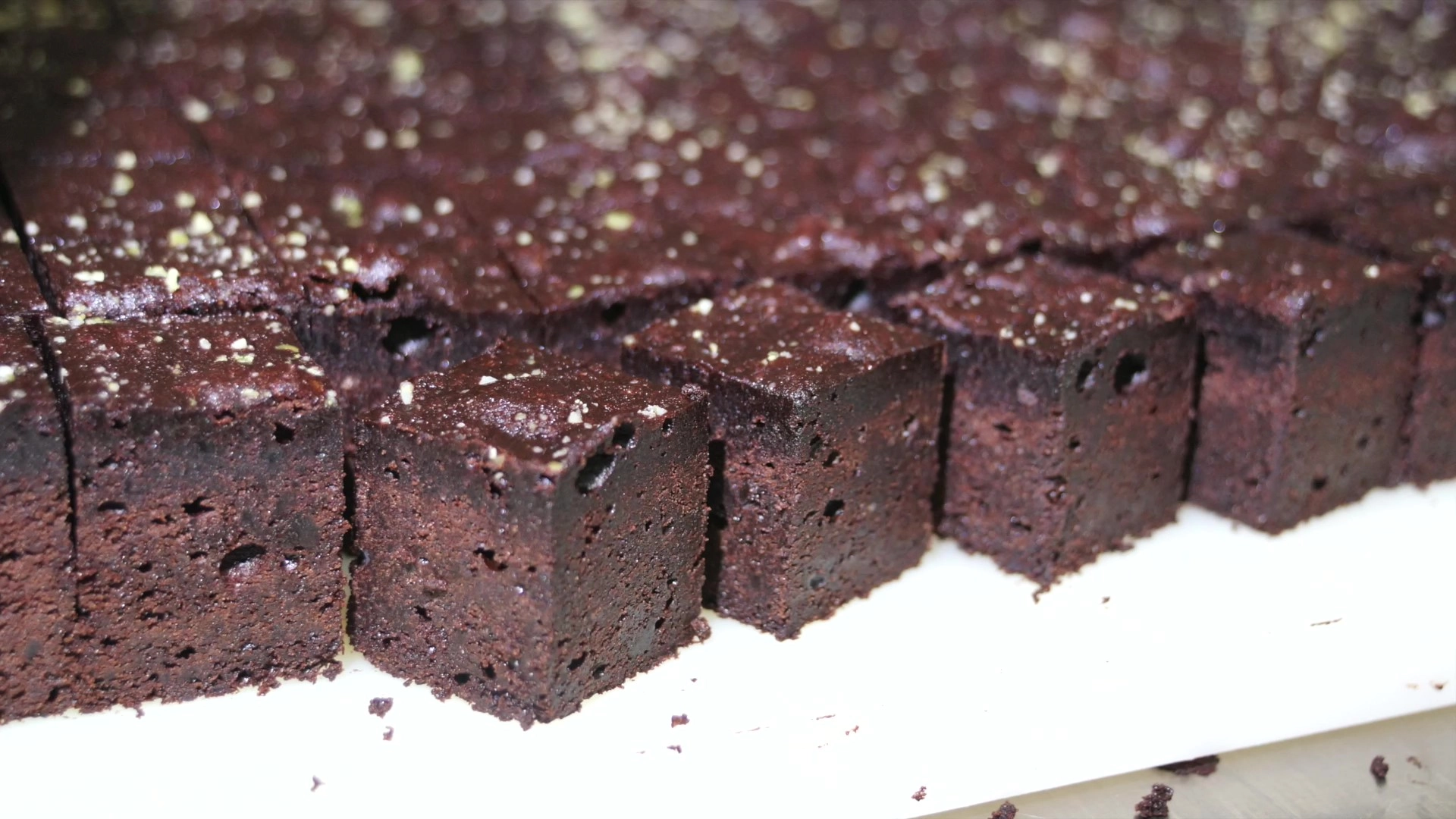
Dense Chocolate Brownie —
rich chocolate and fat content create a compact, fudgy structure.
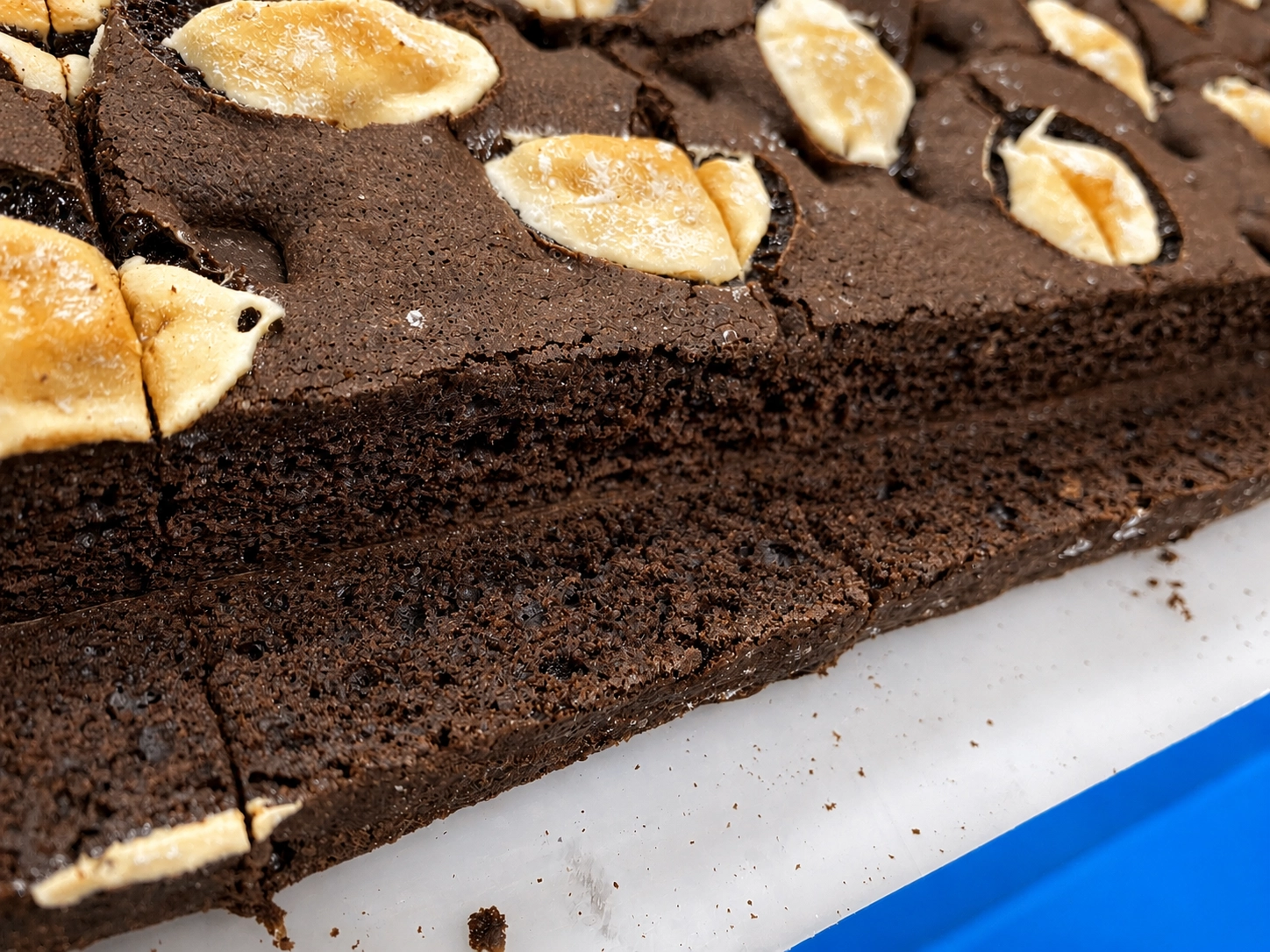
Marshmallow Brownie —
another recipe, another structure, and another set of cutting questions.
Engineering observation
Same product category. Different engineering stories.
The challenge
The Producer Was Not Looking for a New Recipe
The dense brownie in this story had already become the product the producer wanted to sell: rich chocolate, a high-fat formulation and the dense eating experience customers expected.
The difficulty appeared in production. The existing saw slicer could control portion size accurately, but this richer, denser brownie no longer matched the practical cutting window of that process.
Decision point
Your recipe should define the cutting process—not the limitations of the machine.
Before investing in another cutting system, the producer had to decide what was actually worth changing.
Three production decisions
What Should Change When the Existing Process No Longer Fits?
01
Simplify the recipe
Make the brownie easier for the existing saw process to handle.
Easier cutting window
Lower process resistance
Texture and eating experience may change
02
Continue manual cutting
Keep the recipe, but accept greater dependence on operator skill and time.
Recipe remains unchanged
Manual flexibility stays available
Throughput and consistency become the constraint
03
Change the cutting process
Adapt the process around the product instead of redesigning the product around the machine.
Recipe remains the reference
Production can scale more consistently
Another technology becomes worth evaluating
None of these was simply a machine decision.
Each decision affected product identity, production capacity and operational reality.
Engineering observation
Accurate Size Control Was Only Part of the Decision
The producer was not choosing between a “good” and a “bad” cutting method. The real question was which approach best matched this product and this production goal.
Existing options still had value
Saw / steel blade cutting
Accurate dimensions within a suitable working window
Mature and familiar production methods
Practical for many dense or semi-frozen products
What mattered in this case
The producer’s evaluation
Product temperature and deformation
Material loss and visible smearing
Blade maintenance and downtime
Ability to keep the rich recipe unchanged
Ultrasonic cutting was ultimately selected because it better supported
the brownie the producer wanted to keep making.
The product stayed. The production objective stayed.
The cutting process changed.
For this producer, changing the process created more value
than changing the recipe.
This was one engineering decision for one specific product.
Different recipes, volumes and commercial priorities can reasonably
lead to different cutting choices.
No cutting technology is ideal for every product or production environment.
The objective is not to prove ultrasonic cutting universally better,
but to determine which engineering approach best supports the product
the producer wants to make.
ENGINEERING EVIDENCE
What the producer actually received
The discussion was no longer about choosing a machine.
It was about whether the finished product still met the producer's own standard after cutting.
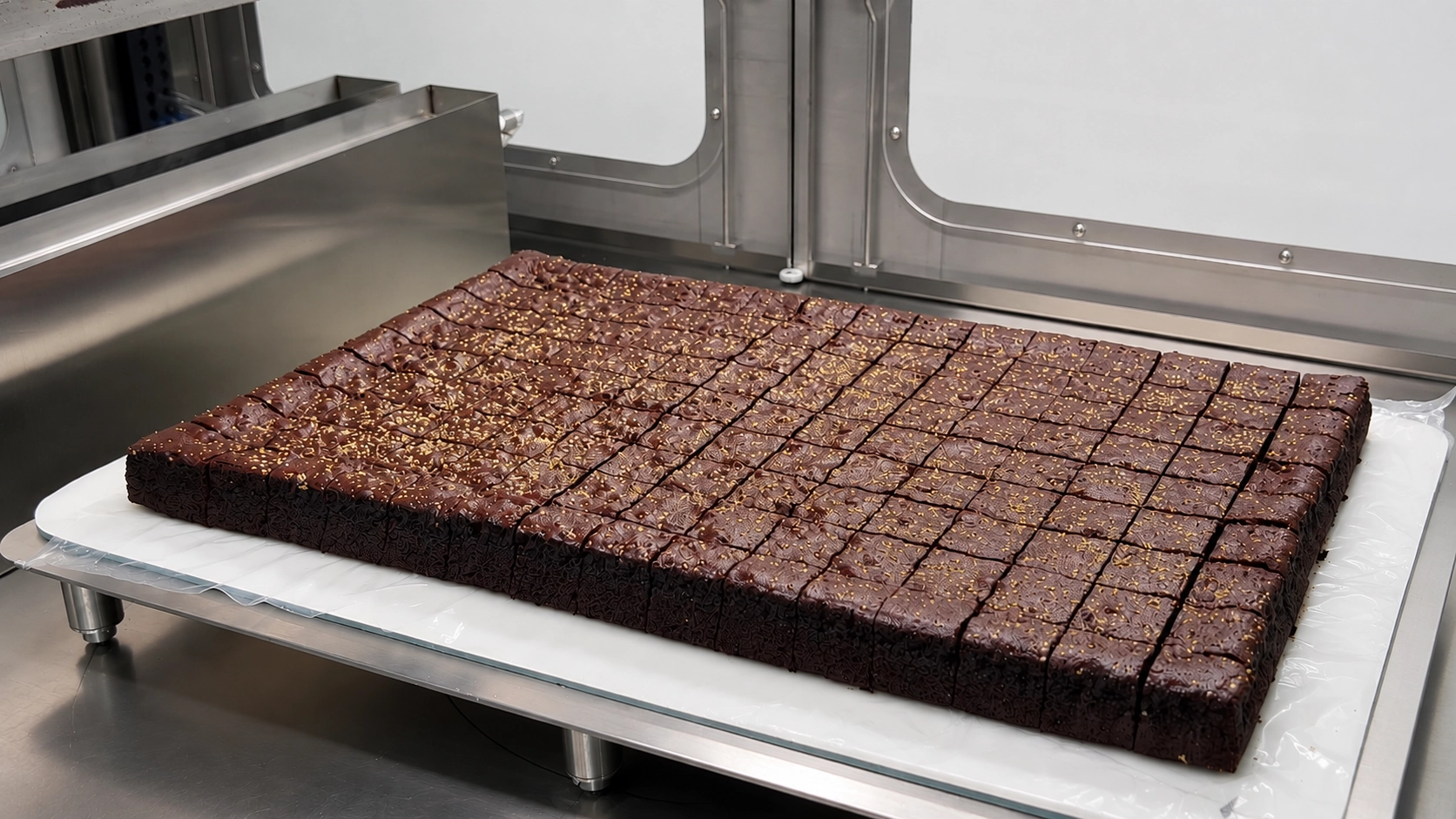
Finished production sheet.
Immediately after cutting, the brownie remained ready for the next production step without additional manual repositioning.
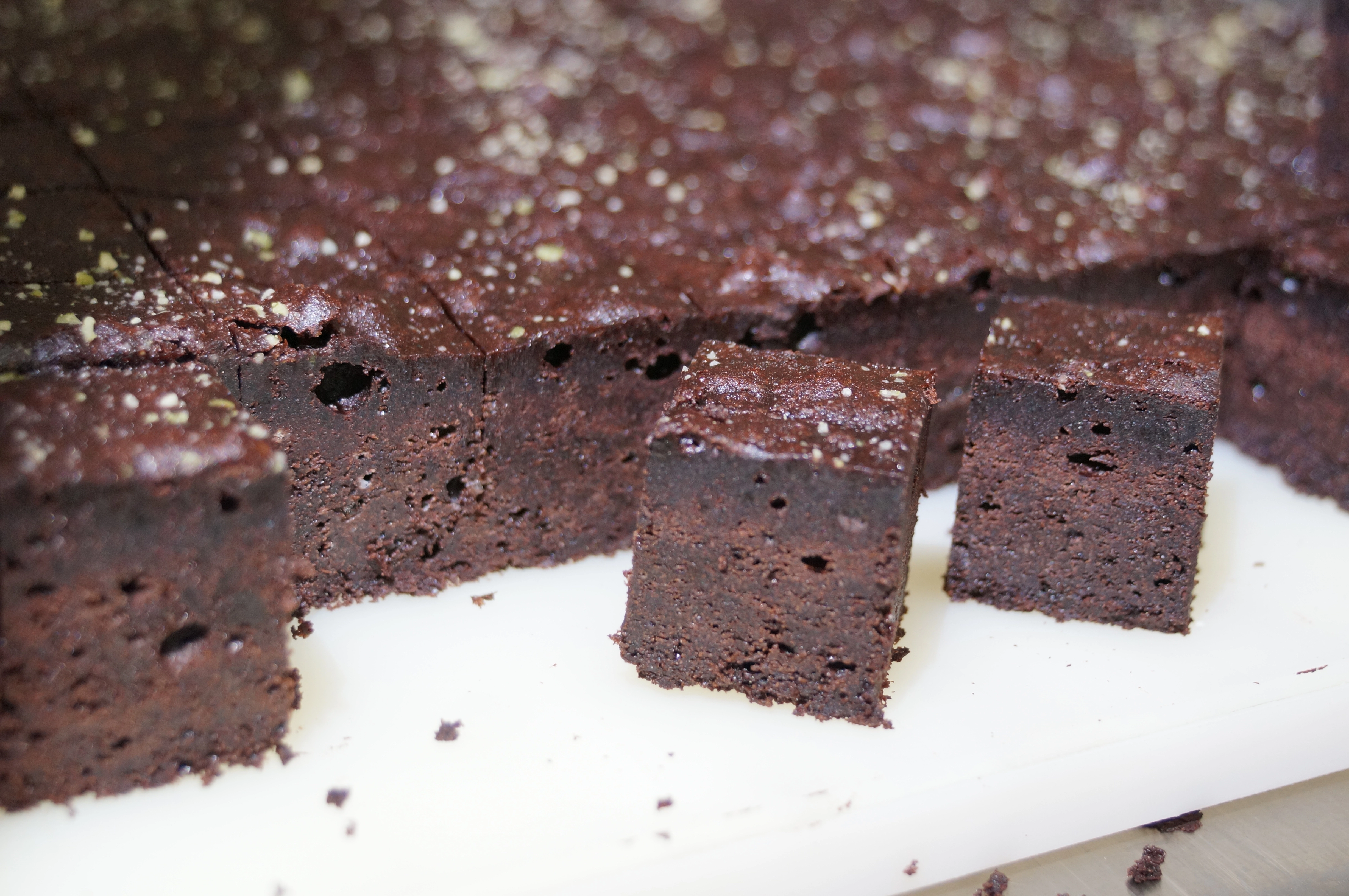
Dense brownie cut surface.
The original photo without additional retouching, showing the actual cutting result.
Watch the actual cutting process
The photographs show the finished result.
The video shows how the product moves through the actual cutting cycle under production conditions.
Ultrasonic cutting—or improving another process?
The answer depends on the product, the production rhythm and where the real bottleneck exists.
The right decision always begins with understanding the product—not selling a machine.
FAQ
Brownie Cutting FAQ
Yes. Saw cutting can provide accurate portion control when the brownie recipe and product temperature fit its working window. This story describes one dense, rich formulation where the producer eventually needed a different approach.
Sometimes reformulation is the right production decision. In this case, however, the dense chocolate texture and rich formulation were part of the product identity, so the producer preferred to evaluate a process change instead.
Every cutting technology has strengths, limitations and an appropriate application window.
The goal of a production evaluation is not to prove one technology superior to another, but to identify which approach best supports the product, production objectives and commercial priorities.
Start with the product and the production goal: what must be preserved, what is currently limiting production, and which compromises are commercially acceptable. Equipment comparison comes after those questions.
START WITH YOUR PRODUCT
Every Product Has a Different Engineering Story.
Every engineering decision starts with understanding the product, not the machine.